In Miami, “the Hispanic market” isn’t a segment you add on at the end of a campaign — it’s the market. The majority of Miami-Dade residents are Hispanic, Spanish is spoken in most households, and the city’s culture, food, music, and business life are shaped by communities from across Latin America. A brand that treats Hispanic consumers as an afterthought isn’t reaching a niche in Miami; it’s missing most of the room.
The mistake most brands make is thinking Hispanic marketing means translating their English ads into Spanish. It doesn’t. The brands that win here market in-culture — they build from the values, humor, and references their audience actually lives, in the language mix people actually speak. This playbook walks through how to do that, the way an agency rooted in Miami approaches it.
“Hispanic” is not one audience
The biggest strategic error is treating Hispanic consumers as a single group. Miami alone is home to large Cuban, Venezuelan, Colombian, Nicaraguan, Honduran, Puerto Rican, Dominican, Argentine, and Mexican communities — each with its own slang, humor, music, food, political history, and buying habits. A campaign that lands with one may fall flat or even offend another.
The differences that matter for marketing include:
- Country and culture of origin — references, idioms, and humor are not interchangeable across nationalities.
- Generation and acculturation — a first-generation immigrant, a bilingual millennial, and a third-generation, English-dominant Latino consume media and respond to messaging very differently.
- Language preference — Spanish-dominant, English-dominant, and bilingual audiences each need their own creative, not a single translation.
Before any creative work, define which Hispanic audiences the brand is actually trying to reach. The more specific the segment, the more the work resonates — and generic “Latino” messaging is exactly what gets ignored.
Bilingual by default, not translated as an afterthought
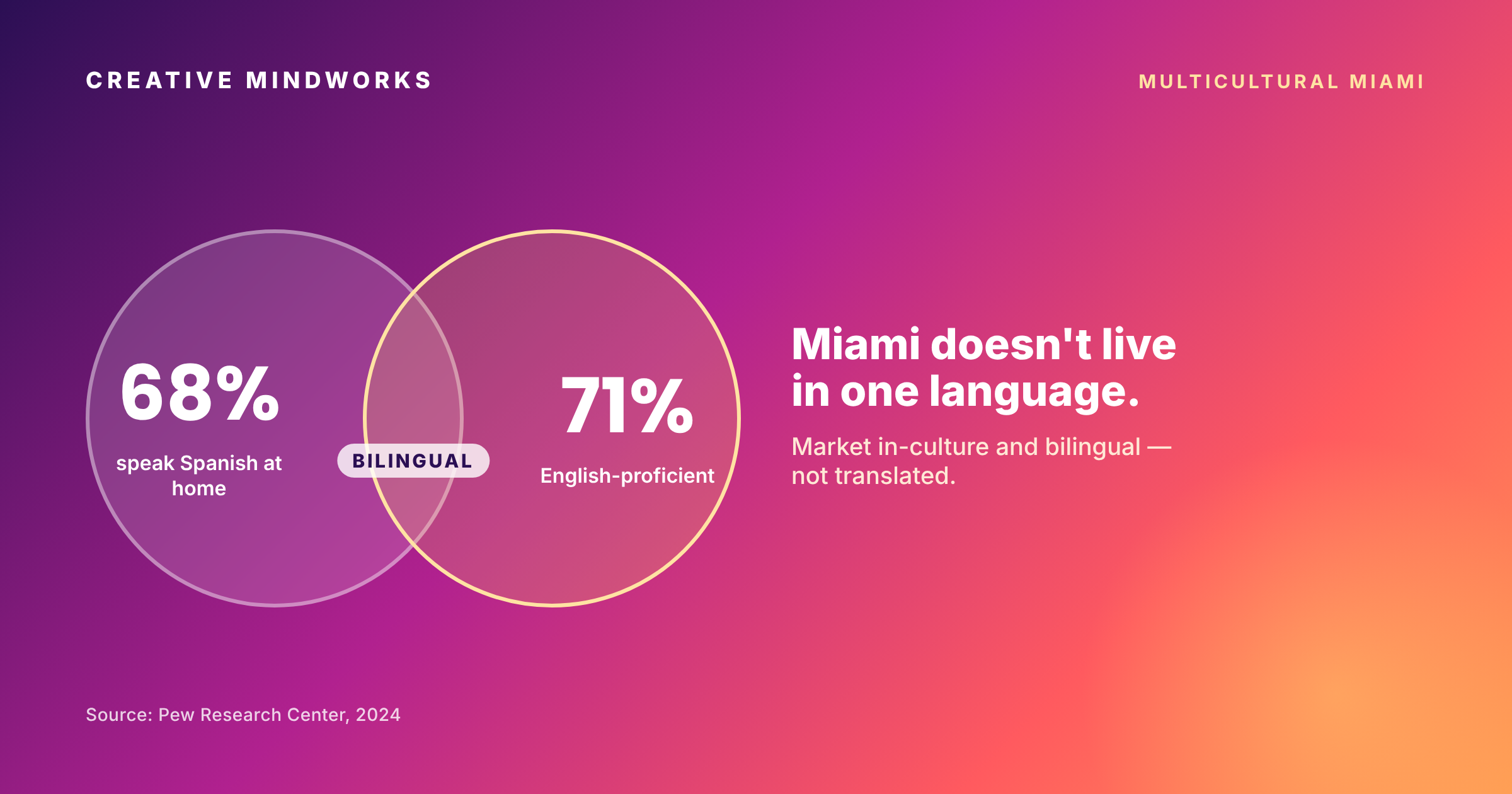
In Miami, people don’t live in one language — they move between Spanish and English constantly, often in the same sentence. Marketing that insists on choosing one language, or that reads as a stiff translation, feels off to the ear it’s meant to reach.
Three principles keep language authentic:
- Transcreation, not translation. Adapt the idea so it works in the target language and culture — the pun, the emotion, the call to action — rather than converting words one-to-one. A tagline that’s clever in English is often meaningless when translated literally.
- Write in the language people think in. For Spanish-dominant audiences, lead in Spanish, authored by native speakers — not run through a translation tool. For bilingual audiences, Spanglish and code-switching can be exactly right when it’s genuine.
- Match the platform. The language mix on a TikTok creator video, a radio spot, and a formal brochure won’t be the same. Meet people where and how they already communicate.
Done well, language isn’t a box to check — it’s the first signal that tells a consumer “this brand actually gets me.”
Culture carries the message
Language gets you in the door; culture is what makes people feel seen. The most effective Hispanic campaigns are built on shared values and lived experience, not stereotypes or a sombrero-and-maracas version of “Latino.”
The cultural threads that consistently resonate:
- Family and community. Decisions are often made with family in mind — messaging that honors that lands harder than individualistic appeals.
- Pride and authenticity. Audiences can instantly tell when a brand respects their culture versus when it’s borrowing it for a campaign. Specific, real, and proud beats generic and safe.
- Food, music, and celebration. These are cultural shorthand — used genuinely, they create instant connection; used as cliché, they backfire.
- Representation that’s real. The people, voices, and creators in the work should reflect the actual audience, made with them, not just about them.
This is why Miami-rooted creative matters. CMW’s work for brands like Valentini, ATALA, and IMUSA connects because it comes from inside the culture — built by people who live it, not translated from the outside in.
Where Hispanic consumers actually are
Hispanic consumers in the U.S. over-index on mobile, social, video, and streaming — they are among the most digitally engaged audiences in the country. Reaching them means showing up on the platforms and formats they use most, not just the ones a brand is used to buying.
The channels that tend to perform:
- Mobile-first everything. Many Hispanic consumers are smartphone-dominant, so creative, sites, and checkout flows must be fast and flawless on a phone.
- Social and short-form video. Instagram, TikTok, YouTube, and WhatsApp are central — especially creator-led, culturally native content over polished brand ads.
- Hispanic creators and influencers. Partnering with trusted local and cultural voices earns credibility money can’t buy directly.
- Streaming and connected TV. Spanish-language and bilingual streaming reaches audiences who’ve moved beyond traditional cable.
- Radio and audio. Spanish-language radio and podcasts still carry real weight in markets like Miami.
The winning media mix is usually bilingual, mobile-centric, and creator-driven — built around where attention actually is, then measured and optimized like any performance campaign.
Mistakes that cost brands the Hispanic market
Most failures aren’t from bad intent — they’re from treating Hispanic marketing as a translation exercise instead of a strategy. The recurring mistakes:
- Literal translation. Running English creative through a translator and calling it a Hispanic campaign. It reads as foreign and inauthentic.
- Treating all Hispanics as one group. Ignoring the differences between nationalities, generations, and language preferences.
- Stereotype-driven creative. Leaning on clichés instead of real cultural insight.
- Afterthought budgeting. Allocating a token amount to “the Hispanic version” rather than planning for it as a core audience from day one.
- No native voices in the room. Making work about a community without anyone from that community shaping it.
- Ignoring measurement. Not tracking Hispanic-segment performance separately, so you never learn what’s actually working.
Every one of these is avoidable with the right partner and the right process — which is what the playbook below lays out.
The playbook: a campaign that resonates
Here’s the step-by-step approach we use to build Hispanic campaigns that perform:
- Define the exact audience. Which nationalities, generations, and language preferences? Specificity is the foundation of everything that follows.
- Start from cultural insight. Research what the audience values, watches, and responds to — then build the strategy from that insight, not from a translated English brief.
- Transcreate the message. Develop the core idea natively in the right language mix, authored by people who live the culture.
- Cast and create authentically. Use real voices, creators, and talent that reflect the audience, produced with them.
- Build a mobile-first, bilingual media plan. Match channels and language to each segment — social, creators, streaming, audio.
- Launch, measure by segment, and optimize. Track Hispanic-audience performance on its own so you can double down on what works.
The thread through all six steps: insight first, translation never. When culture drives the strategy, the creative and media take care of themselves.
Work with a Miami agency that lives this
Marketing to Hispanic consumers well isn’t a service you bolt on — it’s a capability you either have in the building or you don’t. Creative Mindworks is a Miami creative marketing agency built around multicultural work, with bilingual teams and a track record of brand campaigns made from inside the culture, not translated into it.
If you’re trying to reach Hispanic consumers in Miami and beyond, see how we approach it on our Hispanic & Multicultural Marketing page — or get in touch for a free look at your market and audience.
Creative Mindworks — creative, multicultural, and AI-driven marketing, from Miami.

Phillip Gallego
Phillip Gallego is a Partner at Creative Mindworks, a Miami and San Diego marketing, web development and AI agency. He writes about branding, websites, AI search and real estate marketing.
View profile